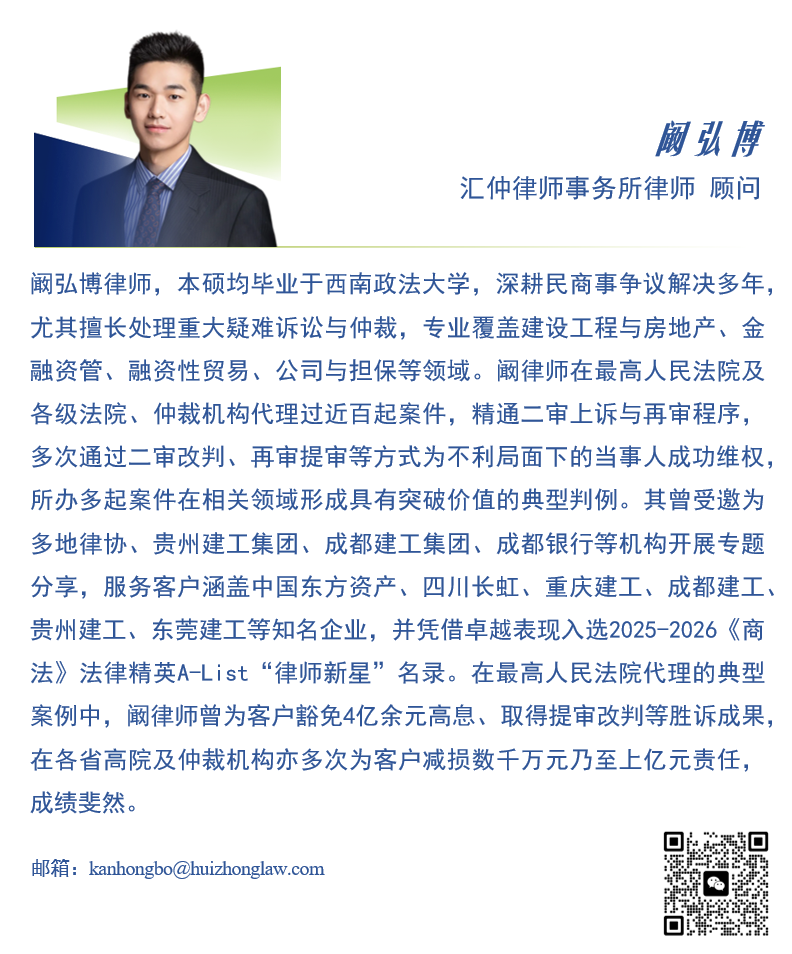

文|阚弘博
By Hongbo Kan
近日,汇仲律师事务所阚弘博律师团队代理的一起8.8亿余元“融资建设回购”纠纷,获最高人民法院提审并取得再审改判胜诉。
案涉交易融合融资、建设与分期回购:总包单位先行筹资并完成工程,发包方在工程移交后分期支付回购价款。工程已经交付,发包方却连续欠付。更棘手的是,合同既未约定加速到期,解除又会打破已经深度履行的交易安排,原审因此仅支持到期款项。
再审阶段,团队从交易实质出发,提出参照分期付款买卖规则,并结合预期违约制度,请求剩余价款一并到期。最高人民法院最终采纳这一裁判路径,支持剩余价款加速到期并否定发包方期限利益。这一纯法律适用裁判,为融资建设回购类案提供重要参考:
Recently, the team led by Lawyer Kan Hongbo of Hui Zhong Law Firm secured a favorable remand judgment from the Supreme People’s Court in a dispute involving a Build-Transfer financing transaction worth over RMB 880 million.
The underlying transaction integrates financing, construction and installment repurchase arrangements. The general contractor funds and completes the project upfront, and the project owner pays repurchase installments after project handover. Though the works were fully delivered, the owner fell into successive payment defaults. Complicating matters, the contract contained no acceleration clause. Terminating the agreement would disrupt the deeply performed transaction structure, so the original court only ordered payment of matured installments.
At the remand stage, our team analyzed the substantive nature of the transaction and argued for the application of rules governing installment sales alongside the doctrine of anticipatory breach to demand full acceleration of all outstanding payments. The Supreme People’s Court adopted our judicial reasoning, denied the owner’s entitlement to the benefit of payment terms, and ordered full acceleration of the remaining repurchase installments. This ruling delivers authoritative judicial guidance for similar financing-construction repurchase disputes purely on issues of statutory interpretation.

「迷局」——工程已经交付,回购价款却要再等七年
就案涉项目,客户总包单位不仅负责施工,还要自行筹集建设资金。发包方在建设期仅支付10%价款,剩余90%在工程移交后分7年等额回购,并支付投资收益。
实际上,案涉工程已竣工验收、移交并使用,工程价款亦经审定,客户主要合同义务已履行完毕,仅剩质保义务;此时,发包方核心义务则转化为按期支付回购价款。
但实际上,发包方未按约付清10%工程进度款,亦在第一、第二期回购价款到期的情况下连续停付。且在本案再审期间,第三期价款亦届期,发包方更未履行原二审判决确定的付款义务。
基于此,案涉工程已经交付,发包方已享有工程投入收益,若继续认定其享有期限利益,放任其违约行为后果,将严重损害客户总包单位的合法权益,亦有违公平原则。
The Dilemma: Completed Works, Seven More Years of Waiting for Repurchase Payments
Under the BT contract, our client, the general contractor, bore full responsibility for construction financing. The owner only covered 10% of project costs during the construction phase, with the remaining 90% payable in seven equal annual repurchase installments plus investment returns following project delivery.
The project passed completion acceptance and was handed over to the owner for full operation, and construction costs had been formally audited. Our client had fulfilled nearly all core contractual obligations, retaining only minor warranty liabilities. The owner’s primary contractual obligation thus became timely payment of repurchase installments.
Nevertheless, the owner failed to settle the initial 10% progress payment and defaulted consecutively on the first two repurchase tranches. The third installment also fell due during the remand proceedings, yet the owner still refused to comply with the payment obligations set out in the second-instance judgment.
The owner had already derived full operational benefits from the delivered project. Sustaining its right to deferred payment would sanction its repeated breaches, severely prejudicing our client and violating fundamental principles of equity.

「难点」——合同不解除,未到期价款能否请求
原审仅支持已到期价款,对于剩余未到期价款,以合同未约定加速到期,亦无法规可循,且以发包方主观愿意履约为由,径行认定未到期部分须待逐年届期后另行主张。
该裁判结果实质系放任发包方违约责任后果,加之其经营能力持续恶化,最终将导致客户背负未来履约风险,有违法益规范价值及公平原则。
此外,因案涉合同已深度履行,质保义务履行尚未届期,且合同约定的解除后果对客户极为不利,贸然诉请解除亦将使客户权益受损。
因此,本案核心难点是:在合同继续有效的前提下,发包方持续违约是否足以使其丧失期限利益?在缺少合同约定、直接法律规定和明确类案先例的情况下,能否主张全部未付价款加速到期。
Core Legal Hurdle: Can Unmatured Installments Be Claimed Without Contract Termination
The original judgment only awarded matured payments. For outstanding unmatured installments, the lower court held that without an express contractual acceleration provision or explicit statutory basis, and based on the owner’s professed willingness to perform, all future tranches must be claimed separately upon each respective maturity date.
This ruling effectively tolerated the owner’s continuous default. Coupled with its deteriorating financial position, the judgment exposed our client to prolonged unquantified performance risks, contradicting the legislative purpose of protecting contractual rights and equitable principles.
Additionally, the contract had been substantially performed, and warranty obligations had not yet fallen due. Contract termination would trigger severely unfavorable consequences for our client under the agreed termination clauses, making a termination claim inadvisable.
The core question at issue: where a defendant is in persistent material breach while the contract remains in force, should it forfeit its benefit of payment terms? Without express contractual wording, clear statutory provisions or binding precedent, could we successfully argue full acceleration of all outstanding receivables?

「破局」——穿透合同名称,重构加速到期的裁判路径
代理团队提出,案涉合同虽包含施工内容,但不能由单一建设工程规则调整;判断剩余价款能否提前请求,应结合实际履行识别交易实质。对此,代理团队提出本案争议处理路径为:
其一,主张类推适用《民法典》第646条分期付款买卖规则。因工程移交后,双方权利义务关系已固定,案涉合同状态符合“买卖合同一时性”特点。在发包方连续欠付两期,欠付比例超过全部分期价款的五分之一的情况下,具备参照分期买卖合同加速到期条件。
其二,主张适用《民法典》第578条预期违约制度。期限利益不应以发包方主观意愿判断,还应审查其持续违约和客观履约能力。故代理团队围绕发包人持续拒付、涉及多起被执行案件,经营情况严重恶化组织证据,将抽象的信用风险转化为可审查的履约事实。
Breakthrough Strategy: Disregard Nominal Contract Label to Establish a Grounds for Payment Acceleration
Our counsel argued that despite construction-related wording in the BT agreement, the matter could not be governed solely by construction contract rules. Entitlement to early repayment must be determined based on the substantive performance of the transaction. We advanced two independent legal lines of reasoning:
Analogical application of Article 646 of the Civil Code governing installment sales. After handover, the parties’ mutual rights and obligations were fixed, creating a single completed transfer relationship analogous to a one-off sales transaction. The owner’s successive defaults covered more than one-fifth of total repurchase consideration, satisfying the threshold for payment acceleration under installment sale rules.
Application of the anticipatory breach doctrine under Article 578 of the Civil Code. Entitlement to deferred payment cannot be judged solely by a party’s subjective intent; objective financial capacity and a pattern of persistent default must be weighed. Our team compiled comprehensive evidence proving the owner’s serial enforcement proceedings and severe operational decline, translating abstract credit risk into verifiable factual grounds for anticipatory breach.

「改判」——核心再审主张进入最高院裁判说理
最高人民法院再审判决认定,案涉合同属于非典型有偿合同,可以依据第646条参照适用买卖合同规则;工程移交后的履行关系与分期付款买卖高度相似。发包方连续欠付金额超过全部分期价款的五分之一,且经催告仍未履行,剩余五期回购价款应当加速到期。
判决同时依据第578条评价发包方的持续违约及客观履约能力,并明确指出:“主观意愿不能替代客观履约能力。”
据此,代理团队提出的两条法律路径,完全被最高人民法院采纳,并作为核心裁判理由。
最终,最高人民法院据此撤销原判决,支持剩余回购价款加速到期,确认总包单位8.8亿余元本息债权,并支持在7.27亿元本金范围内享有建设工程价款优先受偿权。
Supreme People’s Court Remand Judgment Adopts Our Core Legal Arguments
The Supreme People’s Court held that the BT contract constituted an atypical onerous contract eligible for the analogical application of sales rules under Article 646 of the Civil Code. The post-handover payment regime bore striking similarities to installment sales. Having defaulted on sums exceeding one-fifth of total consideration despite formal demands for performance, the owner lost its right to deferred payment, and all five remaining repurchase installments were ordered accelerated.
The judgment further evaluated the owner’s persistent non-compliance and impaired solvency under Article 578, explicitly stating: “Subjective willingness to perform cannot substitute for objective capacity to perform.”
Both legal frameworks advanced by our team were fully adopted as the core reasoning of the Supreme People’s Court ruling. The original judgment was set aside, our client’s total claim of over RMB 880 million in principal and interest was upheld, and a construction project priority right was recognized covering the RMB 727 million principal amount.

「示范」——为融资建设回购等复杂类案提供裁判支撑
本案重要裁判价值在于,确认合同继续履行与未到期价款加速到期不当然冲突。对于融资、建设与分期回购交织的复合交易,人民法院可以结合合同履行阶段、违约程度、客观履约能力及利益平衡,实质判断违约方是否仍应享有期限利益。加速到期由此不再只是合同明确约定的结果,可成为预期违约和分期付款规则在特定交易结构中的法律后果。基于此,对于此类缺少先例的重大法律适用争议,如何成功识别规则入口并逐步拆解可裁判的事实要件,将决定案件能否实现逆转。
综上,汇仲专注于境内外重大疑难商事争议解决,依托严谨的案件研判、质量控制与团队协作机制,汇仲长期活跃于最高人民法院及各级人民法院、境内外主要仲裁机构和跨境争议解决一线,并凭借系列具有行业影响力的代表性成果,在中国高端争议解决领域保持领先地位。未来,汇仲将继续在最擅长的领域做到极致,以全球视野处理重大争议,以专业判断回应客户信任,让看似无解的复杂争议,重新显现通往公正结果的可能。
Precedent Value: Binding Judicial Guidance for Complex Financing-Construction Repurchase Disputes
This landmark ruling confirms that acceleration of unmatured payment claims is not inherently incompatible with maintaining a live contract. For composite transactions mixing financing, construction and deferred repurchase, courts may balance the stage of performance, severity of breach, the obligor’s objective financial standing and equitable interests to determine whether the defaulting party retains its benefit of deferred payment. Payment acceleration is now recognized as a statutory remedy stemming from anticipatory breach and installment sales rules, even absent express contractual acceleration clauses. For high-stakes disputes lacking direct precedent, identifying viable statutory entry points and decomposing constituent factual elements is decisive to securing a complete reversal of lower court outcomes.
Hui Zhong specializes in complex domestic and cross-border commercial disputes. Supported by rigorous case assessment, internal quality control and collaborative team mechanisms, the firm regularly appears before the Supreme People’s Court, all levels of domestic courts and major arbitration institutions at home and abroad. We have delivered a series of landmark representative matters and maintain a leading position in China’s high-end dispute resolution market. Going forward, Hui Zhong will continue to refine its core practice, resolve major cross-border disputes with a global perspective and respond to clients’ trust through rigorous professional judgment, unlocking avenues to equitable outcomes for seemingly intractable complex disputes.
作者介绍