
本文转载自微信公众号[数字法学],原文详情请点击文末阅读原文查阅。
This article is reposted from WeChat Official Account Digital Jurisprudence. Please click "Read Original" at the bottom for the full original text.
2026年5月11日晚,浙江大学《人工智能与法学》课程第二讲顺利开讲。本次课程由汇仲律师事务所合伙人杨晓夫主讲,主题为“人工智能与法律”。课程立足争议解决的实务前沿,结合世界各国关于人工智能的最新立法与司法实践,系统探讨了人工智能在争议解决领域的应用与治理问题,同学们受益良多。
On the evening of May 11, 2026, Zhejiang University hosted the second session of its course AI and Law. Xiaofu Yang, Partner of Hui Zhong Law Firm, delivered the lecture themed Artificial Intelligence and the Law. Rooted in frontline dispute resolution practice and drawing on the latest AI legislation and judicial practices worldwide, the lecture systematically explored AI applications and governance within dispute resolution, offering profound insights to all attending students.

引言:争议解决的本质与律师的核心能力

吴亦全与杨晓夫的合照
课程初始,杨老师指出,要判断人工智能在争议解决领域的实际能力,首先要理解争议解决领域的三项本质特性。第一,法律的滞后性:法律总是落后于商业社会的发展,规则的更新远慢于交易模式的演进。第二,争议解决的偶发性:在实践中,多数商业交易并不会走到争议诉讼这一步,真正进入诉讼程序的案件在业务发生总量中只占小部分。第三,案件处理的非科学性:律师追求的是经过证据规则过滤后的“法律真实”。律师的工作核心是“说服”,这种说服更近于像是一门“艺术”,而非机械地规则适用。三项特性叠加,意味着争议解决领域可供人工智能学习的高质量数据较少,案件的高度个性化,使得人工智能规则化迁移的空间有限。
争议解决可概括为五个阶段:原始事实与资料搜集→法律事实与争议问题的提炼→法律检索→策略形成→阶段性意见与开庭。资料搜集与法律检索两个环节AI辅助价值最为显著,而案件走向的法律事实提炼、策略形成与开庭表现,仍然是高度依赖律师的专业判断和临场反应。
由此,杨老师争议解决律师真正难以被替代的能力概括为三项:Shape your mind, Eye for relevance, Advocacy。在此之上,应当要具备“六个S”的特质: Speed, Speak, Sharp, Sensitive, Sense与Psycology,作为法律人,要有基于经验形成的快速判断力和人际反馈的识别能力。
Introduction: The Essence of Dispute Resolution & Core Competencies of Lawyers
At the opening of the lecture, Mr. Yang outlined three intrinsic characteristics of dispute resolution that define AI’s practical capabilities in this field.
1.Legal Lag: Legislation always lags behind commercial development, with legal rules updated far more slowly than evolving transaction models.
2.Sporadic Disputes: Most commercial transactions never escalate to litigation; only a small fraction of business matters result in formal court proceedings.
3.Non-scientific Nature of Case Handling: Lawyers pursue "legal truth" filtered by rules of evidence, and their core work centers on persuasion — an art rather than mechanical rule application.
The combination of these three traits means limited high-quality standardized training data is available for AI in dispute resolution, while the highly individualized nature of cases restricts AI’s capacity for rule-based generalization.
Dispute resolution can be broken down into five sequential phases:Raw Fact & Document Collection → Extraction of Legal Facts & Disputed Issues → Legal Research → Strategy Formulation → Interim Legal Opinions & Court Hearings
AI delivers the most significant auxiliary value in document gathering and legal research. By contrast, identifying legally consequential facts, building case strategies and courtroom advocacy remain heavily reliant on lawyers’ professional judgment and on-the-spot responsiveness.
From this framework, Mr. Yang distilled three irreplaceable core strengths for dispute resolution practitioners: Shape your mind, Eye for relevance, Advocacy
Beyond these foundational strengths, legal professionals should embody six key qualities dubbed the "Six S":
Speed, Speak, Sharp, Sensitive, Sense, Psychology
Lawyers must develop rapid judgment and the ability to read interpersonal feedback forged through years of practice.
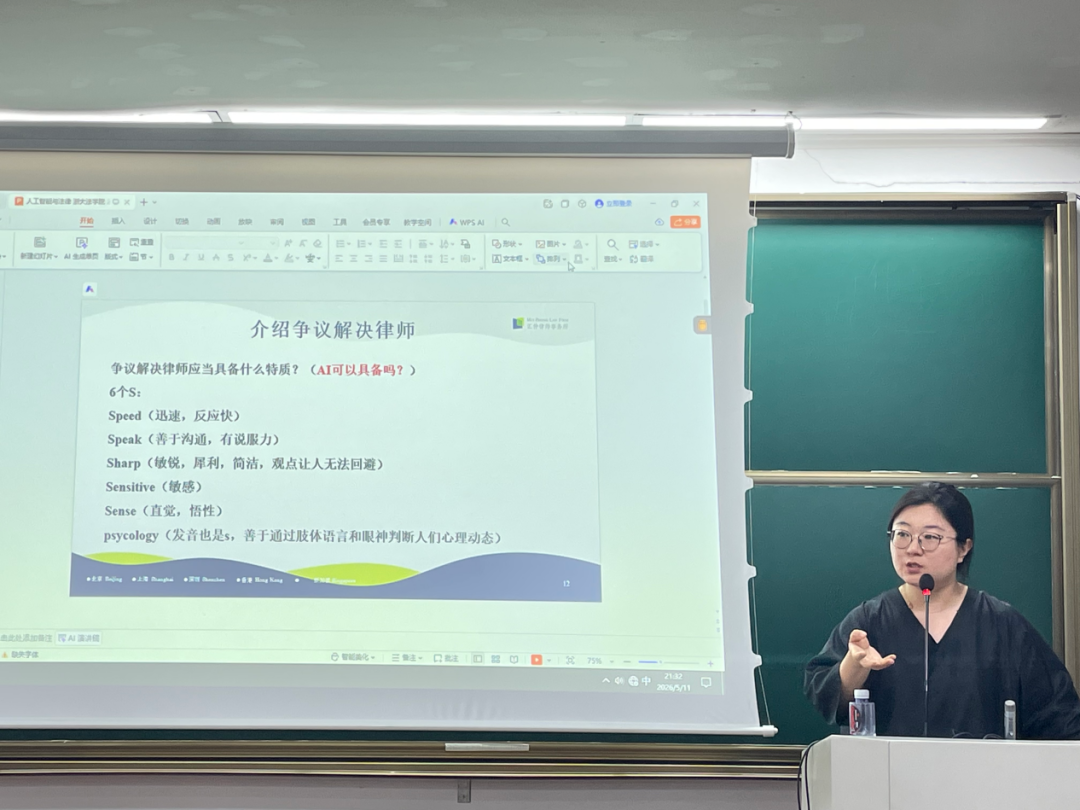
杨晓夫介绍争议解决律师需要具备的技能

AI for Dispute Resolution:人工智能与争议解决中的应用
(1)AI在律师工作中的能力边界
杨老师结合本人代理的多起复杂案件,将AI在律师工作中面临的能力边界归纳为三类典型情境。
第一,原始事实的穿透。许多案件的破局点是从看似与争议无关的细节中识别出非显性线索,这类发现高度依赖律师对相关性的判断,难以被规则化迁移到模型中。
第二,人际互动场景。证人盘问、自然人客户的深度沟通、庭审临场反应,本质上是高度不可控的人际过程。AI难以替代律师对当事人的心态变化、对话节奏与人际反馈的实时把握。
第三,无先例的创造性论证。AI高度依赖训练数据中已有的规则与先例,而“在没有现成答案时构建新答案”,恰恰是争议解决律师价值的核心所在。
(2)全球AI仲裁平台的兴起
杨老师指出,目前人工智能在仲裁领域已有较多探索,也取得了一定的效果。但在实务中人工智能的应用主要集中于小额案件、批量案件与调解辅助。美国仲裁协会(AAA)已在特定领域案件中部分了AI仲裁来提供解决方案。在我国,广州仲裁委员会则将AI用于处理大量案情清楚、证据充分的批量纠纷,并将大模型应用于立案与调解辅助。
但在更具复杂性与价值争议的大型商事仲裁中,各机构均明确要求仲裁员审慎使用人工智能,最终签发权与裁决责任始终归属仲裁员。这是各国、各机构共同坚守的边界。
(3)AI能否成为裁判者:全球司法立场的趋同
围绕“AI能否成为裁判者”这一根本问题,英美与中国的立场已出现明显趋同。
英国高等法院王座法庭庭长Dame Victoria Sharp DBE提出,普通法的核心司法理念是“人为理性”,经过长期学习与经验积累形成的理性,是机器所不能复刻的;卷宗主事官Sir Geoffrey Vos指出,机器无法完全模拟人类的情感与共情,法律的温情与非技术维度恰是AI最难触及的部分;芝加哥大学Eric Posner教授则提出“官方故事悖论”,认为AI仅能从司法判决的形式说理中学习,无法触及裁判背后的真实动机与制度动态。
2026年4月,加拿大魁北克高等法院因仲裁员在裁决说理中引用虚构学说与判例、构成对裁决权的委托,撤销了该仲裁裁决,并系统列举了AI在司法语境中的五项风险:虚构引用与幻觉、缺乏自由裁量与价值判断、可能放大算法偏见、保密性问题、对司法公信力的损害。
我国最高人民法院《关于规范和加强人工智能司法应用的意见》指出,无论技术发展到何种水平,人工智能都不得代替法官裁判,裁判职权始终由审判组织行使,司法责任最终由裁判者承担。无论是普通法系的“人为理性”还是我国的“辅助审判原则”,所共同维护的都是司法判断最终由人承担的制度伦理。
AI for Dispute Resolution
(1) Boundaries of AI’s Capabilities in Legal Practice
Drawing on his track record handling complex cases, Mr. Yang categorized three core scenarios exposing AI’s functional limits.
1.Uncovering hidden raw facts. Many case breakthroughs hinge on identifying obscure clues buried in seemingly irrelevant details — a skill dependent on human contextual judgment that cannot be standardized for algorithmic learning.
2.Human interaction scenarios. Witness cross-examination, in-depth client consultations and real-time courtroom responses involve highly unpredictable interpersonal dynamics. AI cannot replicate a lawyer’s ability to gauge parties’ mental states, modulate conversation rhythm and respond to emotional cues in real time.
3.Innovative legal argumentation without binding precedent. AI operates entirely based on existing rules and precedents embedded in training data. Creating novel legal reasoning when no ready-made authority exists constitutes the core professional value of dispute resolution lawyers.
(2) Rise of Global AI Arbitration Platforms
AI has seen wide trial deployment in arbitration with measurable practical outcomes, yet its current application is largely confined to small-value, bulk claims and mediation support.The American Arbitration Association (AAA) has deployed AI tools to generate proposed resolutions for select categories of disputes. In China, the Guangzhou Arbitration Commission leverages large language models for case filing assistance and mediating high-volume straightforward disputes with complete evidence.
For high-stakes, complex commercial arbitrations, all arbitral institutions mandate extreme caution when utilizing AI. Final award issuance and full adjudicatory liability rest solely with human arbitrators — a universal boundary upheld across all jurisdictions and arbitration bodies.
(3) Global Convergence on Whether AI May Act as Adjudicator
Across common law jurisdictions and China, judicial authorities have reached a consistent consensus on the fundamental question of AI serving as decision-makers.
1.Dame Victoria Sharp DBE, President of the Queen’s Bench Division of the High Court of England and Wales, stated that common law is built on "human reason" cultivated through lifelong study and experience, a faculty irreplicable by machines.
2.Sir Geoffrey Vos, Master of the Rolls, noted AI cannot fully simulate human empathy and compassion, the humanistic dimension of law most inaccessible to algorithms.
3.Professor Eric Posner of the University of Chicago proposed the "official narrative paradox": AI only learns from the formal reasoning of judgments and cannot access the true policy motives and institutional dynamics underlying judicial rulings.
In April 2026, the Superior Court of Quebec, Canada vacated an arbitral award after the arbitrator relied on fabricated legal theories and precedents generated by AI, amounting to a delegation of adjudicative authority. The judgment outlined five core judicial risks posed by artificial intelligence: AI hallucinations and fictitious citations, lack of human discretionary value judgment, amplification of algorithmic bias, confidentiality breaches, and erosion of judicial credibility.
China’s Supreme People’s Court issued the Guidance on Regulating and Strengthening the Judicial Application of Artificial Intelligence, clarifying that no level of technological advancement may replace judges’ adjudicative power; judicial authority and liability shall always rest with human judicial panels.
Both the common law principle of "human reason" and China’s auxiliary AI judicial framework uphold the core institutional ethic that final judicial judgment remains a human responsibility.

AI in Dispute:人工智能引发的法律争议
(一)中国的应对路径
目前,我国陆续出台专门规范来应对人工智能引发的法律争议,包括《生成式人工智能服务管理暂行办法》《互联网信息服务深度合成管理规定》《互联网信息服务算法推荐管理规定》以及《数据安全法》《个人信息保护法》等,已经构建起涵盖算法治理、数据合规、深度合成与生成式服务的初步制度框架。
(二)全球四大共同难题
杨老师将当前全球AI司法面临的核心争议归纳为四类。一是训练数据版权合规:美国依赖合理使用四因素分析,欧盟实行“TDM例外+选择退出权”。二是AI生成内容保护:主流观点坚持“以人类创作为核心”原则,难点在于剥离人类智力贡献是否达到受保护的阈值。三是对AI模型本身的保护:涉及法律定性、模型蒸馏等新兴技术的侵权认定标准、行为正当性边界等多重争议。四是数字复制品的人格权侵权与商业滥用问题。
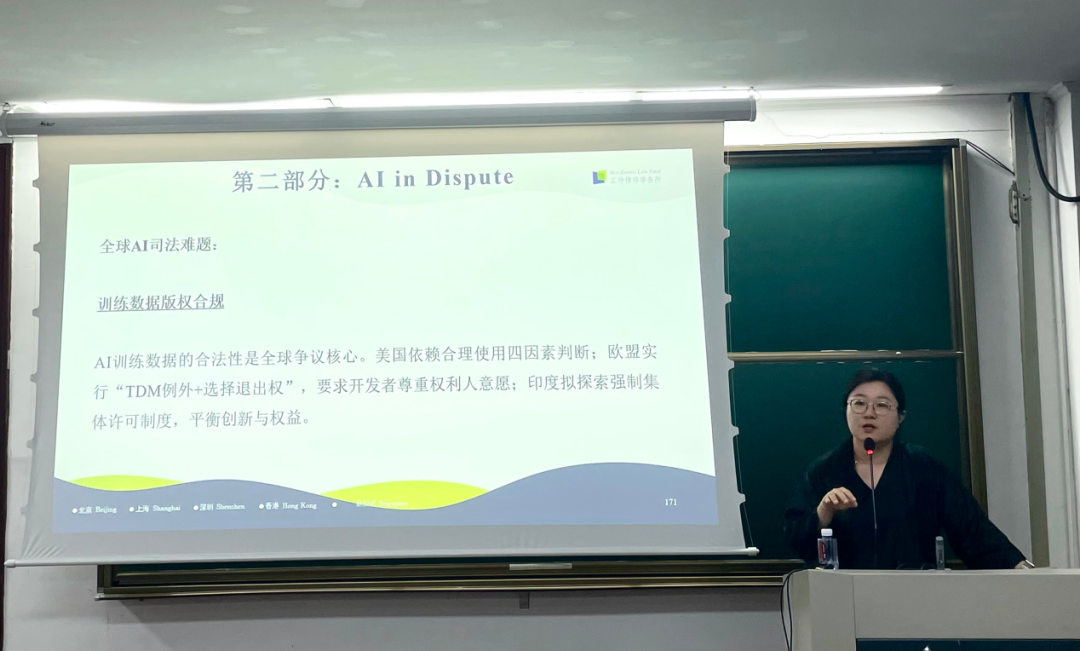
杨晓夫梳理全球AI司法难题
(三)美国训练数据合规的最新判例与研究
在上述四类难题中,以美国近期的判例与研究为例,杨老师着重介绍了训练数据版权合规的问题。
2025年Bartz v. Anthropic与Kadrey v. Meta两案中,加州联邦法院初步认定将受版权保护书籍用于模型训练属于“高度转换性”行为;但同时划定红线,认为获取盗版数据库中的书籍本质上是侵权行为,模型输出端的高保真“反刍”会破坏合理使用第四要素。
2026年1月,斯坦福与耶鲁研究团队披露:包括OpenAI、Anthropic、谷歌、xAI在内的主流大模型已对训练数据中受版权保护的书籍形成深度记忆,能近乎逐字复现书中的长篇段落,且当前对齐手段无法彻底消除这一现象。研究由此得出关键结论:记忆并非可被对齐手段消除的“程序漏洞”,而是当前LLM工作方式下不可分割的“固有特征”。只要模型依赖海量语料的参数化留存来获取卓越的表达力,这种对底层数据的深度记忆就无法避免。
Legal Disputes Arising from Artificial Intelligence
(1) China’s Regulatory Framework
China has rolled out a suite of specialized regulations governing AI-related legal risks, including the Interim Measures for the Administration of Generative Artificial Intelligence Services, Provisions on the Administration of Deep Synthesis Internet Information Services, Provisions on the Administration of Algorithm Recommendation Internet Information Services, alongside the Data Security Law and Personal Information Protection Law. Together they form an initial regulatory system covering algorithm governance, data compliance, deep synthesis and generative AI services.
(2) Four Universal Global AI Legal Dilemmas
Mr. Yang summarized four core contested legal issues facing judicial systems worldwide:
1.Copyright compliance of AI training data: The U.S. adopts a four-factor fair use test, while the EU implements text and data mining (TDM) exceptions paired with opt-out rights.
2.Legal protection of AI-generated content: The prevailing standard centers on human creative contribution; the critical threshold lies in determining whether human intellectual input meets the eligibility standard for copyright protection.
3.Intellectual property protection for AI models themselves: Complex debates surround the legal classification of large models, infringement standards for model distillation, and the legitimate boundaries of related technical conduct.
4.Personality rights infringement and commercial exploitation of digital human replicas.
(3) U.S. Recent Case Law & Research on Training Data Copyright
Focusing on training data copyright compliance, Mr. Yang analyzed landmark U.S. judgments and academic studies.
In the 2025 Bartz v. Anthropic and Kadrey v. Meta litigations, U.S. District Courts in California preliminarily ruled that training large models on copyrighted books constitutes highly transformative use under fair use. However, the courts drew a clear red line: scraping books from pirated databases inherently amounts to copyright infringement, and high-fidelity verbatim output from models violates the fourth fair use factor.
In January 2026, research teams from Stanford and Yale University published findings showing leading LLMs including OpenAI, Anthropic and Google retain near-verbatim long excerpts of copyrighted books within training memory, which current alignment techniques cannot fully eliminate. The study concluded deep textual memorization is an inherent, inseparable feature of large language architectures rather than a fixable programming bug, so long as models rely on parameterized storage of massive corpora to deliver robust linguistic capability.

未来展望

吴亦全总结
本次课程从争议解决实务视角出发,探究了人工智能与法律的关系。可以预见,在不远的将来,人工智能应用于更多的法律工作环节会成为常态,当事人借助AI获得初步的法律咨询,律师在检索、起草与案例研究中将拥有越来越强大的工具,仲裁机构与法院的程序也会更多地引入AI辅助。但是那些真正决定案件走向的判断仍将由法律人完成。在繁杂的材料中识别关键事实,在没有先例的难题中找到新的解题思路,这些都是AI时代法律人需要具备的核心能力。
人工智能的兴起提出了新的议题,包括训练数据合规、生成内容的法律地位、数字身份与人格权保护等。当下尚未有标准答案的许多争议,将在未来逐步制定出新的规则,而其中相当一部分规则的形成,将取决于中国法律共同体在具体案件中的探索。
Future Outlook
Closing the session, Mr. Wu Yiquan offered concluding remarks on the lecture’s takeaways.
From a dispute resolution practitioner’s perspective, the lecture mapped the interplay between artificial intelligence and the legal industry. AI auxiliary tools will inevitably become standard across more legal workflows in the near future: clients will access preliminary legal advice via AI, lawyers will leverage powerful models for legal research and case analysis, and arbitral tribunals and courts will integrate AI into procedural administration. Nevertheless, all consequential case determinations will remain the exclusive domain of legal professionals.
Identifying critical facts amid voluminous records and crafting original legal arguments for untested legal questions will remain the irreplaceable core competencies of legal practitioners in the AI era.
The rise of artificial intelligence has introduced unprecedented legal questions covering training data compliance, copyright status of AI-generated content, and personality right protections for digital identities. Many unresolved disputes will be codified into formal legal rules in the coming years, shaped largely through real-case exploration by China’s legal community.
授课合伙人介绍